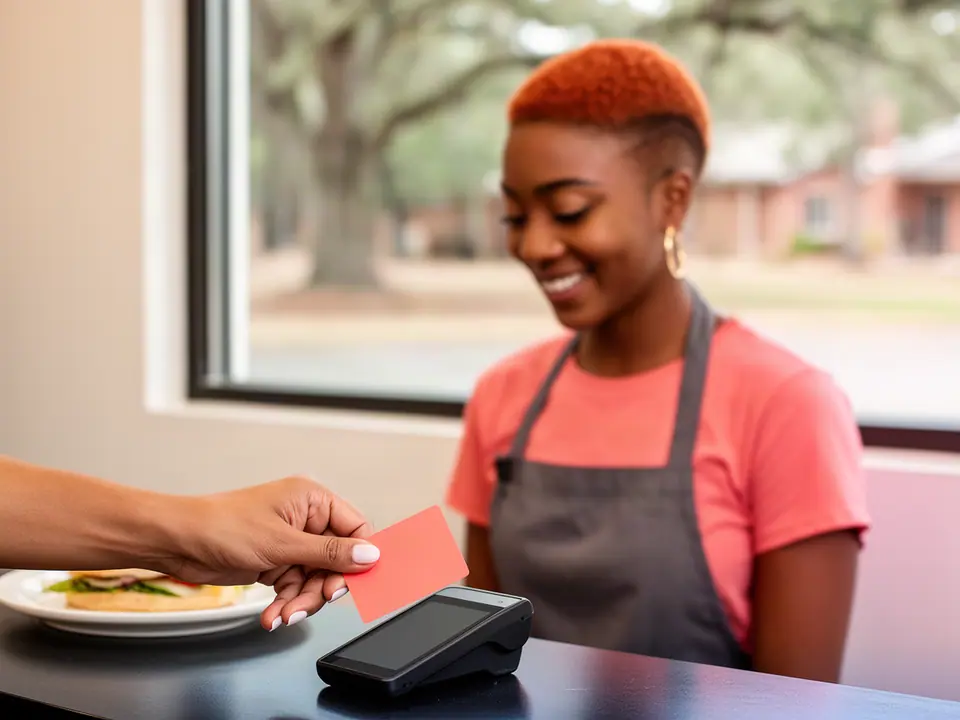
Gas stations, restaurants and coffee shops can call (662) 445-7560 or send the request form; funding providers review it and set the factor rate and holdback.
How a card-sales advance works for Starkville, MS businesses, with a factor rate example, a holdback timeline and a comparison with revenue-based financing.
At a glance
- Gasoline stations, Oktibbeha County, MS
29 employer establishments (CBP 2023)
- Limited-service restaurants, Oktibbeha County, MS
46 employer establishments (CBP 2023)
- Snack and nonalcoholic beverage bars, Oktibbeha County, MS
20 employer establishments (CBP 2023)
How revenue-based financing differs from an MCA for coffee and snack shops in Starkville, MS
Both trade a lump sum now for a share of future sales, but they collect from different places. With an MCA, the provider takes its cut from card receipts, which can be every business day. Revenue-based financing collects a share of total revenue from the business bank account, weekly or monthly as the contract sets, until a set cap is reached. For a coffee or snack shop in Starkville, MS, the MCA ties collection to each day's card batch.
Illustration only, invented figures: under revenue-based financing at 8% of monthly revenue, a shop with $38,000 of revenue in a month remits $3,040 that month; in a lighter month the amount falls with sales.
Twenty snack and nonalcoholic beverage bars with paid staff were counted in the county in 2023 (County Business Patterns, NAICS 722515).
Merchant cash advance or line of credit for an Oktibbeha County, MS clothing shop?
A line of credit charges interest on what is drawn and can be redrawn; a merchant cash advance is a single purchase of future card sales with a fixed total to collect. An Oktibbeha County, MS clothing shop with steady credit and time in business may qualify for a line, which can cost less to carry over a short gap.
An MCA can make sense when a shop needs money against strong card sales and does not fit a partner's line requirements. Its cost is fixed at signing, so collecting it early does not lower the total unless the contract says so.
How a merchant cash advance works for Starkville, MS gas stations
For a gas station in Starkville, MS, a merchant cash advance runs in a few steps:
- The station shares recent card processing and bank statements with a provider.
- If the provider makes an offer, it names three numbers: the advance, the factor rate and the holdback share.
- The station receives the lump sum after signing.
- From then on, the agreed slice of every day's card batch flows to the provider, stopping once the full purchased amount has come in.
Card sales at a station include fuel and in-store purchases, so a provider can look at both. County Business Patterns counted 29 gasoline stations with paid staff in the county in 2023 (NAICS 4471).
What is a factor rate in an MCA for an Oktibbeha County, MS quick-service restaurant?
An MCA factor is the multiplier applied to the advance to determine its collection target. It is written as a decimal, and it applies once to the whole advance rather than accruing over time like interest.
Illustration only, invented figures: a quick-service restaurant in Oktibbeha County, MS takes $20,000 with a 1.30 factor rate. In this example the provider's total collection comes to $26,000, and the $6,000 above the advance is its cost. That cost is the same whether collection takes three months or nine, which is why a factor rate cannot be compared directly with an annual rate. The factor rate to APR calculator converts one to an estimated annual figure.
Is a merchant cash advance a loan for Oktibbeha County, MS coffee and snack shops?
No. A merchant cash advance is structured as a purchase of future receivables, not a loan: the provider buys a share of card sales at a discount, and the shop remits that share as sales come in. There is no interest rate, and the end date depends on the pace of card sales.
For a coffee or snack shop in Oktibbeha County, MS, that means the comparison has to be done on total cost and time to collect. The calculator on this page takes the advance, factor rate, holdback and average daily card sales and shows the total remitted, the cost and the estimated time to remit.
What is a holdback rate for an Oktibbeha County, MS quick-service restaurant?
Holdback is the slice, stated as a percentage, that a provider takes from every day's card sales. A higher holdback collects the advance sooner and leaves less cash each day for the restaurant.
Illustration only, invented figures, continuing the $20,000 advance with $26,000 to collect: a restaurant with $2,400 of average daily card sales and a 12% holdback remits $288 a day. At that pace the total is collected in about 91 business days, rounded up.
If card sales slow, the daily amount falls with them and collection takes longer; the total stays $26,000. Compare that with a working capital loan or a term loan before signing. A restaurant that still prefers the advance can give its annual revenue on the request form and use a call to explain how much of it comes in by card.
Four blog articles go further: how the holdback is collected day by day, revenue-based funding set beside an advance, short-term loans for food and fuel costs as a fixed-payment alternative, and the steps and documents behind each product.
By Jadeglen Loans · Updated